
Make the best use of what is in your power, and take the rest as it happens.
Epictetus
March, 2024
I’m pleased to say that I have submitted my thesis for external examination, and I’m hopeful I will have the results back soon. This has been a labour of love, and I’m proud to say I have done the best work I could possibly do. But I would not have done this alone, and I’m so thankful for all the help and support I received along the way. I’m drafting a summary of findings to share with participants and will make those available once the thesis is published. Watch this space!
November, 2023
Guess what? I’m so excited to announce that I have completed my final seminar this month! Thank you so much to my supervisor, Professor Linda Graham, and Professor Suzanne Carrington, for their mentoring and support. Thank you to my examiners for their thoughtful comments, too! It’s been very busy, indeed. Thank you to the students and their families for sharing their stories. Thank you to the school staff for being part of this work, too. Next week, I will be presenting some of the findings at the Australia Association for Research in Education in Melbourne. Then, I’m taking extended leave to visit my family in Brazil (it’s been 8 years!) and a little holiday in the USA.
April, 2023
Last year, I was invited to join an Advisory Committee to support the production of an e-Resource for the National Disability Coordination Officer (NDCO) Program. This training program is designed for school staff and educators in all sectors who support students with disability who are transitioning or preparing to transition to tertiary education. I’m pleased to say the e-Resource is now live. You can view the training program Secondary Education Staff (Qld)
March, 2023
This month, Hon. Jason Clare MP, Minister for Education, announced the Review to Inform a Better and Fairer Education System (the Review) to advise on what reform priorities should be included in the next National School Reform Agreement (NSRA). Post-school transition was not a big focus in the NSRA previously. I have contributed to a submission for the second National School Reform Agreement study, and I’m hopeful my input has helped bring post-school transition to the forefront of the new agreement in 2024. You can view my contribution as part of the Centre for Inclusive Education’s submission.
December, 2022
In late November, I presented some of the initial findings for the project at the AARE Conference in Adelaide. As part of a symposium presentation, I shared the progress in the project and discussed some of the impacts of Covid disruptions on my research. I also talked about how the support I received as part of the Centre for Inclusive Education HDR Support Network, helped me stay connected and built my resilience during disrupted times.
You can read more about the symposium in the C4IE Blog “Propelling higher degree inclusive education research during disrupted times” or listen to Season 2, Episode 5 of the C4IE podcast, where I talk about my PhD learning experiences along with PhD fellow candidates.
September, 2022
Two exciting news! First, a paper I co-authored with an amazing team has been published in the Australia Journal of Education. The paper “Societal, systemic, school and family drivers for and barriers to inclusive education” examines the drivers and barriers to inclusive education in Australia. You can read more here – note that this paper is not “open access” and you might need to purchase it.
The second exciting news is that I entered a poster about this project in QUT’s Creative Industries, Education and Social Justice HDR Research Showcase. Below is a photo of me in front of the poster (on the right), and another HDR colleague Haley Tancredi (on the left). There were so many creative posters and interesting research projects!
More to come 🙂
January 2022
The second round of student and parent interviews has started for the first participants in the study. It is amazing how much can happen in a short period of time!
December 2021
My first solo publication is out! I’m excited to share that I wrote a chapter in the book New Perspectives on Education for Democracy. The chapter: “Re-imagining Aspirations: A new transition planning framework supporting inclusive and democratic actions in schools” presents the theoretical framework used in the study and aims to expand current understandings of self-determination in post-school transition planning for students with disability.
Read more & get the book here.
Term 3, 2021
August 2021
First round of interviews completed! Yay! Thank you to all students and families for their contributions. So many insights already!
Now back on to transcribing interviews! 🙂
Term 2, 2021
The Voice
This is another little video about the project presented at C4IE HDR The Voice 2021 early in June. To watch the video click the link below!

https://automate.video/many_destinations_or_road_to_nowhere_lmp_2021_5c42cf02
Good news for June
On 1st June, the project received ethics approval to recruit participants with disability (besides autism) who are completing or have recently completed Year 10 in a regular (mainstream) school in Queensland. This was a great outcome and we are hoping we can recruit participants across Queensland to share their transition planning journey.
Do you know a family who may be able to participate? Head to our Participant Information page or feel free to send me an email. I would love to hear from you!
What happened in April?
April was a very busy and short month, with Easter and other Public Holidays. Recruitment is still in progress, we are hopeful we will have all participants registered and interviewed before the end of the term.
I attended a few education workshops in April, including workshops hosted by CRU which is open to all parents. I will be co-facilitating Peer Support Coffee Mornings through QCIE (both online and in-person) in May and June ( see QCIE event dates). Join me and the wonderful QCIE team for a coffee and a chat!
Term 1, 2021
How did this project start?
In 2015, I had the opportunity to work as a research assistant for the project Critical Interventions Framework Part 2 (CIF2) (Bennett et al., 2015), which reported on initiatives across Australia that helped students from equity groups access, participate and succeed at uni. Most of the programs highlighted by this research focused on students from low socioeconomic status (SES) backgrounds; there were hardly any programs available to support students with disability to access and succeed at university.
In the same year, my eldest son was diagnosed on the autism spectrum at age four. I knew little about autism then, but I could see my child and how much potential he had. It was overwhelming and upsetting to hear some statements from health professionals dictating what he was “supposed” to be doing at his age. What would his future look like?
So, the idea for this project came about as I started learning about autism and disability, and what the future holds for many people living with disability in Australia today. Why are there so few opportunities for students with disability to receive support to access and succeed in higher education? What options do students with disability have when they finish school? Did students with disability have “lower aspirations” than students without disability? When and how are aspirations formed? These, and many more questions, led to the initial proposal for this research. I hope the findings from this study can provide valuable insights on how to better support people with disability transitioning out of school and creating a better future for themselves.
References
Bennett, A., Naylor, R., Mellor, K., Brett, M., Gore, J., Harvey, A., James, R., Munn, B., Smith, M., & Whitty, G. (2015). The Critical Interventions Framework Part Two: Equity Initiatives in Australian Higher Education: A Review of Evidence of Impact. https://www.newcastle.edu.au/__data/assets/pdf_file/0016/261124/REPORT-FINAL.pdf
December 2020
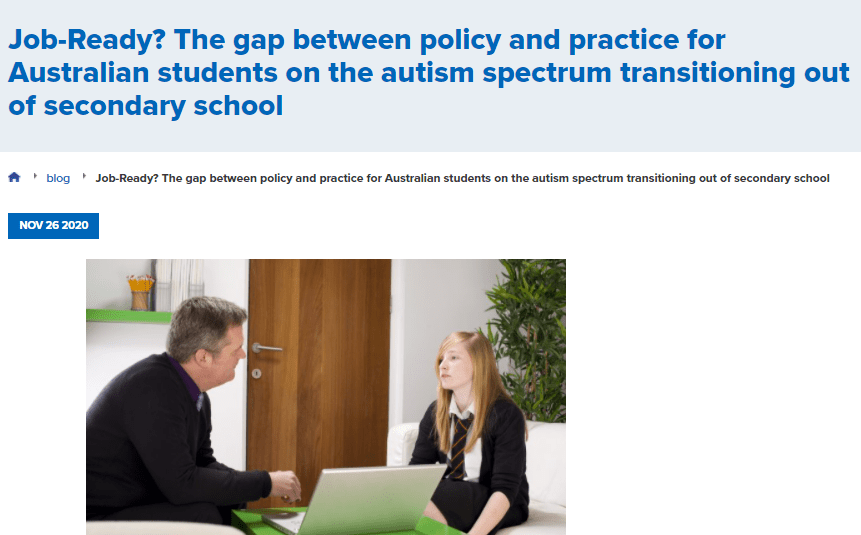
The Centre for Inclusive Education (C4IE) recently published a post about the Aspirations through time project. Read more here.
Term 4, 2020
Welcome! What a year! 2020 was filled with challenges for all of us – we all have been impacted some way, some people more than others (although it is fair to say that we have been somewhat fortunate in Queensland). So it is time to start our project again and we are currently looking for participants. To find out more, go to our participant page.
Term 2-3, 2020
Due to the current COVID-19 restrictions the project has been paused. Recruitment will restart in Term 4, 2020. 😦
Term 1, 2020
We are currently seeking participants! Head to the Participant Information page (top menu) to find out how to participate.
Would you like more visuals?
Do you want to learn more about the research in a different format? These slides were presented at the 2019 HDR Conference at the University of Queensland in October 2019.

https://www.slideshare.net/secret/jM78QfGabOFPrJ
Welcome to Aspirations Through Time Blog
Yes, the title is a mouthful! Maybe it’s enigmatic and confusing… Aspirations have many meanings – you might be able to describe what it means to you (we will talk about aspirations in my next post). But what does “through time” actually mean? We often see the expression “over time”, perhaps “across time”, used in a few situations or contexts or when referring to longitudinal research. Put simply, longitudinal research involves observations over some time. Often, observations in longitudinal studies are set at two points in time: before and after. For this project, however, I would like to gain deeper insights than simply before and after. Therefore, I am using the term “through time” inspired by Johnny Saldana’s (2003) concept of from-through. He describes that observing “through time” offers the opportunity to outline the process of change rather than simply focusing on two different points in time, that is, before and after an event. Thomson and Holland (2003) describe that this type of longitudinal research allows the creation of “moving images” rather than snapshots of participants’ experiences. I guess if you are trying to learn about people’s life experiences, one could say life is a journey, not a destination.
References
Saldaña, J. (2003). Longitudinal qualitative research: Analyzing change through time. CA: AltaMira Press.
Thomson, R., & Holland, J. (2003). Hindsight, foresight and insight: The challenges of longitudinal qualitative research. International Journal of Social Research Methodology, 6(3), 233-244. doi:10.1080/1364557032000091833
 Aspirations Through Time